




A Reel Oregon Coast Field Note
Depoe Bay, Oregon doesn’t gradually introduce you to the Pacific. The town practically drops you into it. Highway 101 runs through the middle of town with shops, restaurants, and galleries on one side and a seawall overlooking the ocean on the other. Waves pound the rocky shoreline below, natural spouting horns send seawater into the air, fishing boats squeeze through a remarkably narrow harbor entrance, and if you happen to look offshore at the right moment, a gray whale may surface close enough to stop just about everyone along the seawall.
That’s what has always struck me about Depoe Bay. It’s a small place geographically, but there’s an enormous amount of Oregon Coast character packed into a very short stretch of shoreline. I put together a full Reel Oregon Coast episode on Depoe Bay, and this field note gives us a little more room to explore the history, harbor, whales, working waterfront, and rugged coastline that make this little town unlike anywhere else along the Oregon Coast.
Depoe Bay, Oregon - "King Tides at the Seawall"

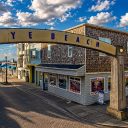
Depoe Bay, Oregon - "Shops, Surf, and Seawall"

A Town Built Against the Pacific
The history of Depoe Bay begins long before Highway 101 brought travelers through town. Indigenous people lived along this part of the Oregon Coast and relied on the area’s abundant marine resources, including fishing and seal hunting. The city’s historical account notes that coastal Indigenous peoples speaking numerous languages lived throughout the broader region and that the natural harbor was used for fishing and seal hunting. Depoe Bay’s early history and the DePoe family also reveal a more complicated story behind the town’s name than a simple one-line origin tale. Depoe Bay eventually incorporated as a city on May 22, 1973.
What developed here was never going to be an ordinary beach town. The coastline is too rugged for that. Sea cliffs, rocky formations, natural spouting horns, caves, and the small opening to the harbor have dictated how people interact with this landscape for generations. Even today, there isn’t much separation between the community and the elements. The highway, buildings, seawall, harbor, and ocean all seem squeezed together into the same narrow strip of land.
Walk along the seawall and you feel that relationship immediately. You’re still in the middle of town, but the Pacific is right there below you. Cars move along Highway 101 behind you while waves crash against the rocks in front of you. Shops and restaurants may be only a few steps away, yet turn toward the water and the experience becomes completely different. Depoe Bay has somehow managed to build a town along one of the most exposed stretches of the central Oregon Coast without ever making the ocean feel distant.
Depoe Bay, Oregon - "The World's Smallest Harbor"

The World’s Smallest Harbor
Depoe Bay’s most famous claim to fame is tucked behind Highway 101: what the city calls the World’s Smallest Navigable Harbor. Covering approximately six acres, the naturally formed harbor connects to the Pacific through a 50-foot-wide, 100-foot-long rockbound channel. North Depoe Creek and South Depoe Creek also feed freshwater into the harbor. The harbor has changed considerably over time, with major development beginning in the late 1930s and additional enlargement and improvements following in subsequent decades. Depoe Bay harbor history traces that evolution in considerably more detail.
Standing beside the harbor, its small size is almost deceptive. Boats are tied to the docks, charter operators prepare for trips, and the water inside can appear relatively protected. Then you look toward the harbor entrance and see the narrow opening through which vessels have to reach the open Pacific. Watching an experienced captain navigate that transition gives you a much better appreciation for the relationship between this town and the sea.
There’s also a little Hollywood history tucked into this tiny harbor. Depoe Bay was used as a filming location for the 1975 psychological drama One Flew Over the Cuckoo’s Nest, starring Jack Nicholson. The City of Depoe Bay’s film history also notes the production’s connection to town. It’s one of those pieces of local history that’s easy to miss if you’re simply passing through on Highway 101.
For me, though, the attraction isn’t really the superlative. It’s the amount of activity squeezed into such a compact space. Fishing boats, whale-watching vessels, recreational boats, charter operations, and the Coast Guard all share this little pocket of protected water. Small harbor, big personality.
Depoe Bay, Oregon - "Whale Watching Center"

Depoe Bay, Oregon - "Up-Close Gray Whale Watching"

Where Whales Come to You
Whale watching is one of the experiences most closely associated with Depoe Bay, and for good reason. Gray whales migrate along the Oregon Coast during their seasonal journeys between northern feeding grounds and the warmer waters near Baja California. Oregon State Parks reports that thousands pass the coast during the winter and spring migrations, while a smaller group remains in Oregon coastal waters through summer and fall. The central coast becomes a particularly good place to look for them during that period.
What makes whale watching here particularly enjoyable is that you don’t necessarily have to get on a boat. The seawall gives you a long, elevated viewing area directly above the Pacific. On a good day, people start gathering whenever someone spots the telltale mist of a whale’s blow. Pretty soon binoculars come out, fingers start pointing, and complete strangers are all staring at the same patch of ocean waiting for the next appearance.
For a closer introduction to what’s happening offshore, the Depoe Bay Whale Watching Center normally provides a viewing deck, binoculars, interpretive displays, and staff or volunteers who help visitors spot and understand whales and other marine life. If you’re planning a 2026 visit, check the official page before going: Oregon State Parks currently lists a construction closure affecting the center and surrounding viewing area during part of summer and fall 2026. Nearby Boiler Bay, Rocky Creek, and Cape Foulweather are among the alternative viewing locations recommended by the state.
I’ve always liked the unpredictability of it. There’s no curtain going up and no guarantee that a whale is going to appear exactly when you want one to. You watch. You wait. And then somebody suddenly says, “There!” That’s part of what makes the experience genuine.
Depoe Bay, Oregon - "Rich and Rugged Vistas"

When the Ocean Blows Back
The whales may get most of the attention, but Depoe Bay has another natural spectacle that requires no wildlife at all. The city’s account of the area’s rugged early coastline specifically identifies the spouting horns among the natural features that have long defined Depoe Bay, along with sea cliffs, caves, terraces, and Arch Rock.
Their personality changes with the Pacific. Under calmer conditions, you may see little more than spray and mist. When the ocean gets more energetic, the same rocky shoreline can send impressive bursts of seawater into the air. Add the sound of waves striking the rocks below and you’ve got one of those Oregon Coast experiences that is far more interesting in person than it sounds when somebody describes it.
That’s also why I wouldn’t automatically dismiss an overcast or slightly rough day in Depoe Bay. Blue skies photograph beautifully, but some of the town’s character comes alive when the Pacific gets moody. Clouds add texture to the horizon, waves become more dramatic, and the rocky shoreline begins showing you why generations of people here have treated the ocean with respect.
That respect matters. The same water that creates the spectacle can be dangerous, particularly during high surf. Before heading out, I always recommend checking National Weather Service coastal conditions and forecasts rather than assuming conditions at the shoreline will match what you encountered inland. Depoe Bay gives you plenty of opportunities to experience the power of the Pacific without needing to challenge it.
Depoe Bay, Oregon - "World Class Fishing Charters"

A Working Harbor
It’s easy to think of Depoe Bay primarily as a visitor destination, but the harbor reminds you that this is also a working maritime community. City documents describe Depoe Bay as a multi-use harbor supporting privately owned vessels, commercial vessels, fishing charters and whale-watching vessels. Charter fishing has long been part of the local maritime economy, with anglers heading offshore for species such as rockfish, lingcod, salmon, halibut, albacore tuna, and Dungeness crab. Depoe Bay’s maritime tourism and fishing activity remain important pieces of the harbor’s identity.
That mixture of tourism and maritime work gives the harbor much of its atmosphere. People aren’t simply strolling around looking at boats tied to docks. Crews are preparing vessels, passengers are arriving, fishermen are returning, and captains are paying attention to conditions beyond the harbor entrance. It feels active because it is active.
The Coast Guard’s history in Depoe Bay dates to the establishment of a station in 1940 as an auxiliary to the Yaquina station in Newport. The city’s historical account describes its primary mission as search and rescue for commercial mariners, recreational boaters, and surfers, along with marine environmental protection, fisheries enforcement, towing, and boating-safety responsibilities.
As a Navy veteran, that part of Depoe Bay has always caught my attention. Visitors see a picturesque little harbor; the people who work these waters see something else as well. Beyond that narrow entrance is an ocean that can change quickly, and having trained crews stationed here is a reminder that the beauty and danger of the Oregon Coast have always existed side by side.
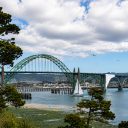
Depoe Bay, Oregon - "Depoe Bay Bridge"

Depoe Bay, Oregon - "Ben Jones Bridge"

Bridges Built for the Oregon Coast
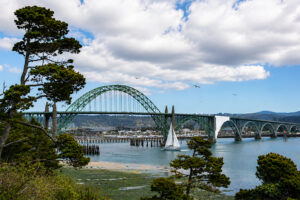
You could easily drive across Depoe Bay’s bridges without thinking much about them, which would be a shame because they belong to a much larger Oregon story. Both the Depoe Bay Bridge and Rocky Creek Bridge were designed by Conde B. McCullough, the legendary engineer whose bridge designs helped define travel along the Oregon Coast. Both were completed in 1927; the Depoe Bay Bridge is 312 feet long, while the Rocky Creek Bridge—also known as the Ben Jones Bridge—measures 360 feet.
McCullough became head of Oregon’s Bridge Division in 1919 and developed a reputation for structures that combined practical engineering with architectural beauty. The state’s own historic bridge documentation describes the Depoe Bay Bridge as an important example of McCullough’s engineering and artistic approach, designed in a way that maintains the beauty of the surrounding coastline.
What I appreciate about McCullough’s work is that the bridges don’t feel like pieces of infrastructure dropped onto the landscape. They feel connected to it. That’s particularly important along the Oregon Coast, where a poorly conceived structure could easily overwhelm the very scenery people traveled here to experience.
And that’s really what these bridges accomplished. They weren’t simply ways of getting across water or ravines. They helped turn the Oregon Coast into a connected journey. Nearly a century later, we’re still using that route to discover places like Depoe Bay.
Fish, Chips and a Window Toward the Pacific
Eventually the salt air has its way with you and it’s time to eat. Seafood is woven into Depoe Bay’s story in ways that go well beyond today’s restaurant menus. The city’s history of the early Depoe Bay salmon bakes traces community fish fries and fish bakes back to the 1930s while also describing traditional coastal Indigenous methods of roasting salmon over open fires.
That history makes the town’s modern connection with seafood feel less like a tourism theme and more like a continuation of something that has been here for generations. Today’s visitor can find casual cafés, seafood restaurants, and fish and chips around town, while the harbor itself remains connected to recreational and commercial fishing. The city’s Eat, Play, Stay Depoe Bay visitor page is a useful starting point for checking current options before your trip.
But eating in Depoe Bay isn’t only about what’s on the plate. Location plays a pretty significant role. Find the right table and the Pacific becomes part of the meal. Depending on where you’re sitting, you might find yourself watching waves roll toward the rocks, scanning the horizon for whales, or watching Highway 101 traffic pass through town.
That’s one of the pleasures of spending time here instead of treating Depoe Bay as a quick stop between Lincoln City and Newport. Park the car. Walk the seawall. Browse the shops. Get something to eat. Watch the ocean for a while. Sometimes a plate of fish and chips with the Pacific outside the window is itinerary enough.
Stay Long Enough to Hear the Town Change
Depoe Bay can certainly be experienced during a day trip, but staying overnight changes the rhythm. Once some of the Highway 101 traffic thins out and day visitors begin moving on, you get a quieter version of the community. The ocean doesn’t leave, of course. If anything, without as much activity competing for your attention, you notice it more.
The town offers a variety of accommodations, and the city’s Depoe Bay visitor information provides a useful place to begin planning. Travelers who would rather sleep among the trees can head a short distance south toward Beverly Beach State Park, where the forest-sheltered campground sits only steps from miles of beach. The park currently offers full-hookup and electrical sites, tent camping, and 21 yurts.
Those yurts can be an appealing middle ground for travelers who like the idea of camping more than the reality of setting up a tent in Oregon Coast rain. Oregon State Parks describes its yurts and cabins as a simpler camping option that provides shelter without requiring campers to set up their own structure. Reservations are strongly recommended, particularly during popular travel periods.
Weather deserves consideration when planning that stay. This is the central Oregon Coast, where a beautiful morning doesn’t necessarily tell you what the afternoon has planned. Layers, a rain shell, and shoes that don’t mind getting wet can be more valuable than trying to predict the perfect day.
I keep a jacket handy even when the day starts looking perfect.
Depoe Bay, Oregon - "Sights, Sounds, and the Sea"

Why Depoe Bay Stays With You
There are larger Oregon Coast towns with more restaurants, more shops, more beaches, and longer lists of attractions. Depoe Bay’s appeal isn’t really about quantity. It’s about proximity. Everything seems compressed together here—the highway, seawall, tiny navigable harbor, Coast Guard station, charter boats, restaurants, bridges, cliffs, spouting water, whales, and Pacific Ocean.
That closeness changes how you experience the place. You don’t have to drive several miles from downtown to find the ocean because you’re already standing over it. You don’t necessarily have to board a boat to search for whales because you can scan the horizon from the seawall. And with Oregon State Parks’ year-round whale-watching information in mind, you begin to understand why looking toward the water becomes almost instinctive when you’re here.
That’s the throughline of Depoe Bay for me. The town has spent generations adapting itself to an extraordinary piece of coastline without ever managing—or perhaps ever wanting—to tame it. The harbor provides shelter from the Pacific, the seawall gives people a place to watch it, bridges carry travelers across the landscape, and the Coast Guard stands ready for those moments when the ocean reminds everyone who’s really in charge.
Depoe Bay isn’t simply a town beside the Pacific. It’s a town that lives with it.
Keep on coasting. — Tony 😉
Watch the Episode
Plan Your Visit: Resources
- Depoe Bay visitor information: City of Depoe Bay
- Whale watching & migration information: Oregon State Parks: Whale Watching
- Depoe Bay Whale Watching Center: Oregon Coast Visitors Association: Whale Watching Center
- Depoe Bay history & Coast Guard: City of Depoe Bay: Coast Guard History
- Camping & yurts near Depoe Bay: Beverly Beach State Park
- Depoe Bay tide predictions: NOAA Tide Predictions: Depoe Bay
- General Oregon Coast trip planning: Oregon Coast Visitors AssociationDiscover Newport
The hotel’s name change is recent enough that older articles, maps, and reviews may still reference “Sylvia Beach Hotel” — worth confirming current details directly with the property before booking.




Leave a reply